Deployment Is Not Destiny:
Robot Recomposition in the Field with Unseen
Software, Hardware, and Compute Payloads
Steven Swanbeck†,
Jonathan Salfity†,
Jeffery Gunawan,
Corrie Van Sice,
Mitch Pryor,
and Robert Blake Anderson
Texas Robotics and the Walker Department of Mechanical Engineering
The University of Texas at Austin
†S. Swanbeck and J. Salfity contributed equally to this work.
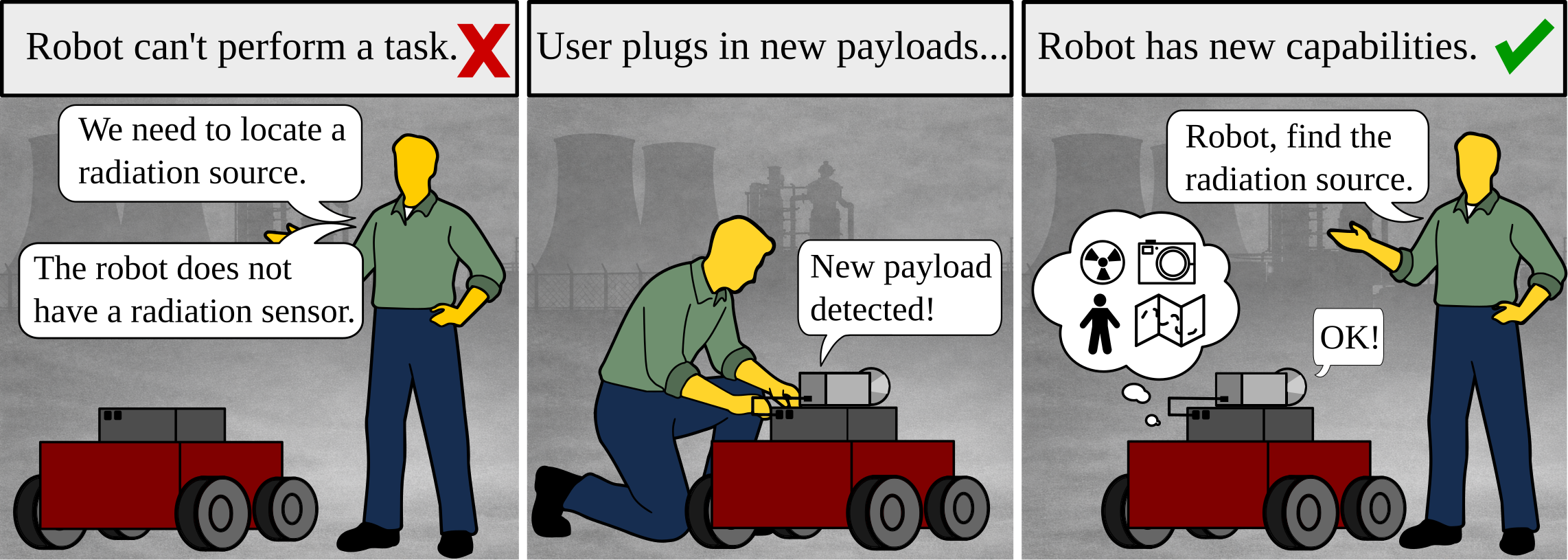
Core Concept: Our framework allows robots to be quickly modified
with plug-and-play unseen payloads for ad hoc tasks. Non-roboticist end-users can
quickly reconfigure a robot in the field without reprogramming, and robots require no prior
knowledge of introduced payloads. Within minutes, a robot can compose new capabilities into
goal-directed task plans.
Abstract
The tight coupling of subsystems in most robots, though a natural consequence of their
complexity, leads to monolithic designs that are time-consuming and difficult to adapt
after initial deployment. To address this challenge, we present a framework and supporting
abstractions for recomposition during runtime that enable robots to quickly integrate
previously unseen modular software, hardware, and compute payloads. Our approach allows
non-expert users to quickly add new capabilities in the field through a true plug-and-play
process. Crucially, new resources are not only immediately available to a host robot but are
also shared with distributed peers, enabling compute-constrained systems to access powerful
new remote capabilities. Our framework reduces reconfiguration time to a matter of minutes
with no developer intervention, in stark contrast to the hours of expert effort often required
for traditional manual integration. We demonstrate our method in two disaster response
scenarios, including radioactive source localization at an operational nuclear reactor facility
and a thermal-guided search for people in dark, difficult-to-reach spaces. These demonstrations
show how in-field recomposition provides timely, flexible, and accessible adaptation to dynamic
requirements, representing a critical step toward creating robots that can quickly evolve
alongside the tasks, technologies, and environments they support.
Approach
Our framework is built around the principle of compositionality: every previously
unseen payload is treated as a self-contained component that can be dynamically integrated
into the robot's decision-making and execution pipeline. Existing low-level interfaces for
each component type — software, hardware, and compute — are unified and extended where
required to produce similar composable properties. A dedicated Component Manager
combines these interfaces into a top-level abstraction that handles component discovery and
utilization during runtime, with no developer intervention and minimal system downtime.
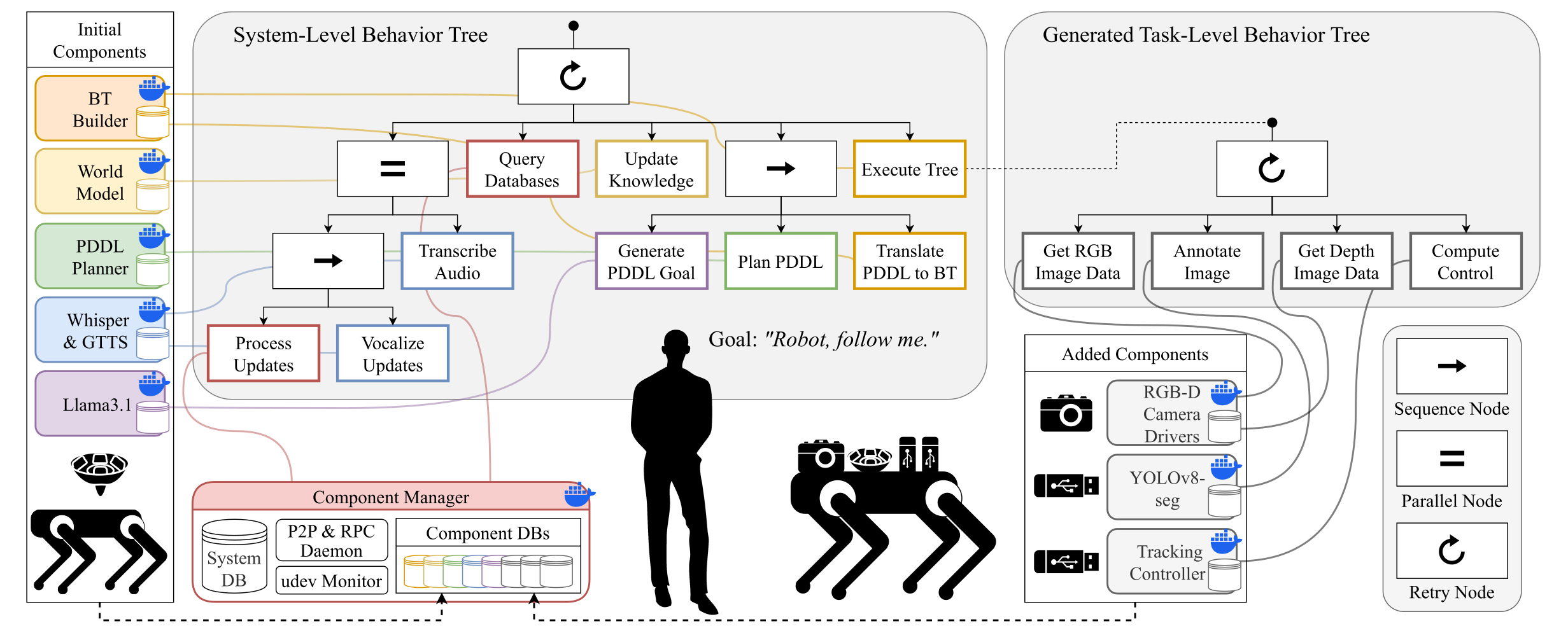
Framework Overview: The system begins with a set of software,
hardware, and compute initial components. Each software component affords a set of
behaviors that are composed into a system-level behavior tree responsible for
processing system updates and task planning. A dedicated component manager is
responsible for discovery and management of unseen added components introduced
during runtime. When provided a task goal, the robot leverages available components —
including those introduced during runtime — to generate and execute a task-level
behavior tree. Behaviors afforded by each component are indicated with color and wires
showing origin.
Component Abstractions
Each component type requires a different abstraction, but all three are unified so that they
expose the same composable properties to the planner and to distributed peers.
SoftwareContainers + databases
Software payloads ship a containerized image plus a keyword-indexed relational database
holding compiled behavior and interface libraries for multiple CPU architectures and PDDL
action, domain, and problem fragments describing the behaviors the payload affords.
Payloads arrive on USB flash drives and are discovered via udev events.
HardwareUSB + rail mounts
Hardware payloads connect over USB and are physically mounted with a rail-based mounting
plate for fast recomposition. Non-block USB devices are automatically mapped into the
containers of concurrently introduced driver software, giving plug-and-play access to
sensors and actuators.
ComputeP2P discovery + RPC
Compute payloads join over Ethernet or WiFi on a predetermined subnet, discover peers via
UDP multicast, and exchange data over TCP. Peers trade component databases on discovery,
so a compute-constrained robot can plan and execute using capabilities hosted elsewhere.
Component Manager
Every robot and external compute payload runs a Component Manager that owns the
lifetime of all other components and reacts to three classes of runtime update:
USB block device updates (scan for valid software payloads, verify CPU
architecture, disk, and GPU memory, then load images and copy databases),
new device nodes (map hardware into the matching driver container), and
peer signaling (exchange databases with newly discovered peers and prune on
disconnect). The system-level behavior tree monitors these updates and re-queries all stored
databases, so plans always reflect the current capability set — local and remote.
Demonstrations
We present demonstrations spanning three host robots and a diverse set of unseen payloads.
Together they validate four key attributes of plug-and-play recomposition during runtime.
A1
Incremental Payload Integration
Adding and removing payloads to provide new capabilities as mission needs evolve.
A2
Distributed Capability Sharing
Sharing newly introduced local payloads and utilizing remote payloads hosted on another peer system.
A3
Host-Agnostic Integration
Reusing the same payloads across different host robots, tasks, and environments.
A4
Concert of Independently Designed Payloads
Cooperation between independently designed unseen payloads to achieve a provided task goal.
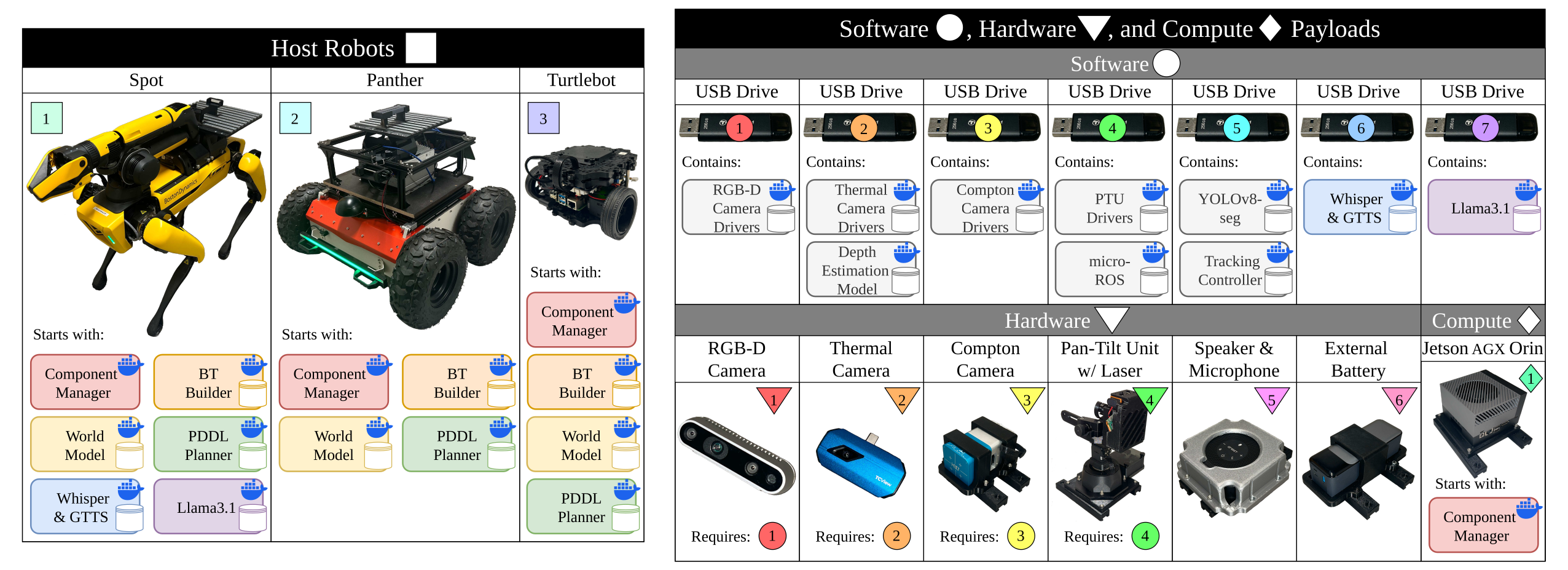
Host Robots and Unseen Payloads: Each host robot and the external
compute payload starts with a subset of the initial software components shown in the
Framework Overview. Software is
injected into host robots during operation via USB drives, each containing one or several
software components. Hardware payloads are mounted during operation via a rail-based
mounting system. Software payloads required to use hardware payloads are indicated. Host
robots and payloads have unique colored identifying tags used throughout both
demonstrations below.
Each host robot has a distinct computational profile: a Boston Dynamics Spot
with an NVIDIA Jetson AGX Orin (64 GB shared RAM/GPU memory, 1 TB disk) in
Demonstration 1; a Husarion Panther with an Intel i9-13900, 64 GB RAM,
1 TB disk, and no GPU; and a Robotis Turtlebot with a Raspberry Pi 4
Model B, 2 GB RAM, 32 GB disk, and no GPU. The external compute payload in
Demonstration 2 is an identical Jetson AGX Orin.
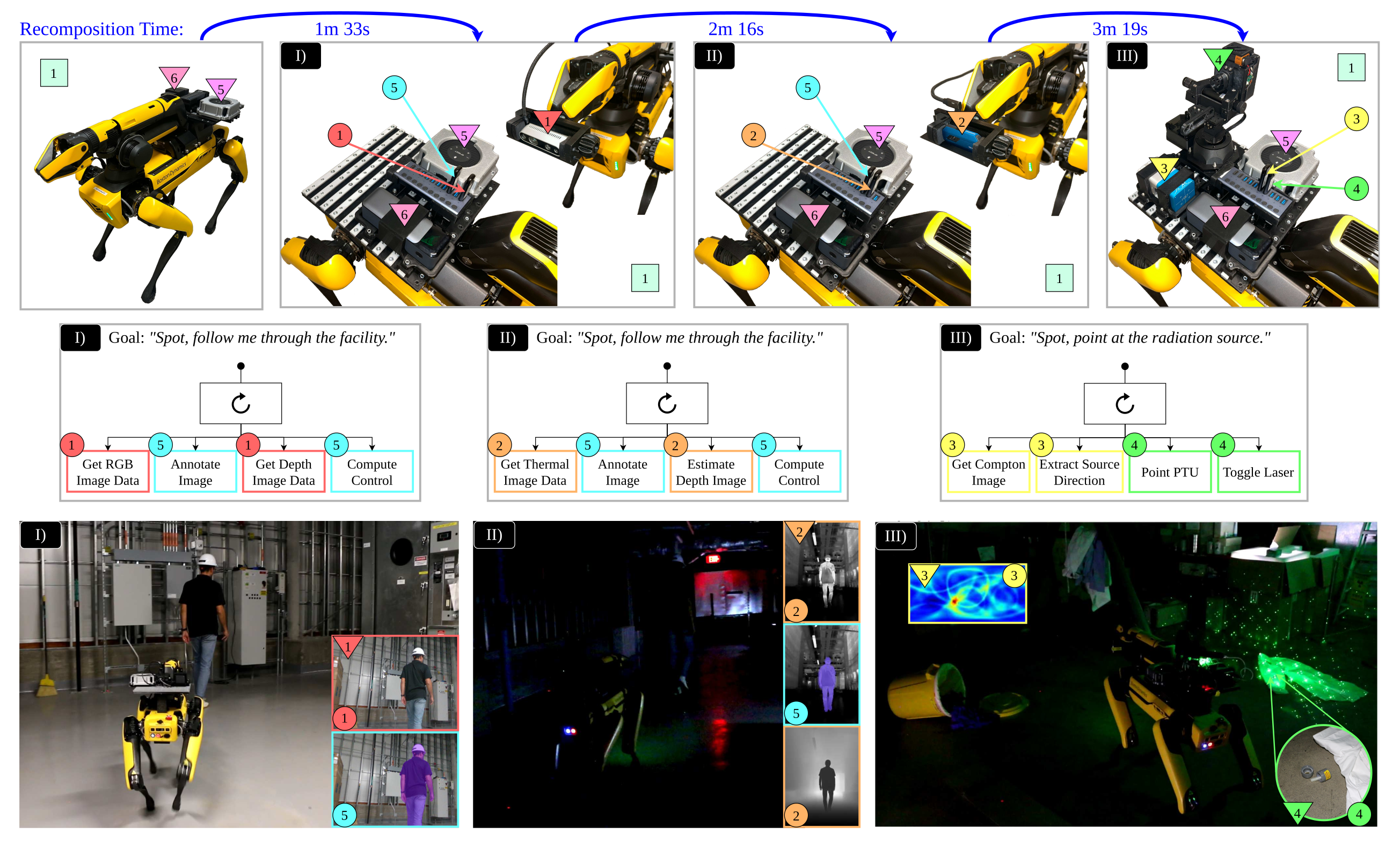
Demonstration 1 — Radioactive Source Localization
Scenario. We mimic a partial blackout at an operational nuclear reactor
during which an internal radiation alarm has been triggered. Demonstrators placed actual
radioactive material out of plain sight, but in a location from which beta and gamma
emissions would be detectable by instruments. A Spot host robot is deployed alongside a
human teammate with a suite of unseen payloads for person tracking and radioactive source
localization.
Stage I — RGB-D person following
The teammate plugs in an RGB-D camera with supporting driver software, a YOLO image
detection model, and a vision-based tracking controller, then issues the goal
"follow me through the facility." The system-level behavior tree generates a
task-level behavior tree for person following, letting the robot traverse the building
without a prior map.
Stage II — Thermal person following in the dark
A blackout kills all lights and the RGB-D camera becomes ineffective. The teammate swaps
the camera and drivers for a thermal camera plus drivers and a monocular depth-estimation
model, then repeats the same goal. The new thermal sensing modality composes with the
already-running detection model and tracking controller to continue through the building.
Stage III — Radiation source localization
On arriving at the contaminated room, the teammate removes the running payloads and plugs
in a Compton radiation camera with drivers and a pan–tilt unit with laser plus drivers.
The goal "point at the radiation source" yields a task-level behavior tree that
detects radiation with the Compton camera and points at it with the PTU laser,
successfully localizing the hidden source.
Demonstration 1: Radioactive Source Localization consisting of
stage I) person-following traversal through the building using an RGB-D camera, stage II)
continued traversal through a dark part of the facility using a thermal camera, and stage
III) radiation source localization and indication with a Compton radiation camera and
pan-tilt unit with laser. The top row shows the unseen payloads plugged into the host
robot during each stage. The middle row shows the user-provided natural language goals
during each stage and the corresponding autonomously generated task-level behavior trees.
The bottom row shows images from third-person perspective and onboard sensor data
collected and processed during task execution. Software and hardware tags match
Host Robots and Unseen Payloads,
and behaviors and robot data snapshots indicate the components that enable them.
Recomposition time for each stage is shown above the top row.
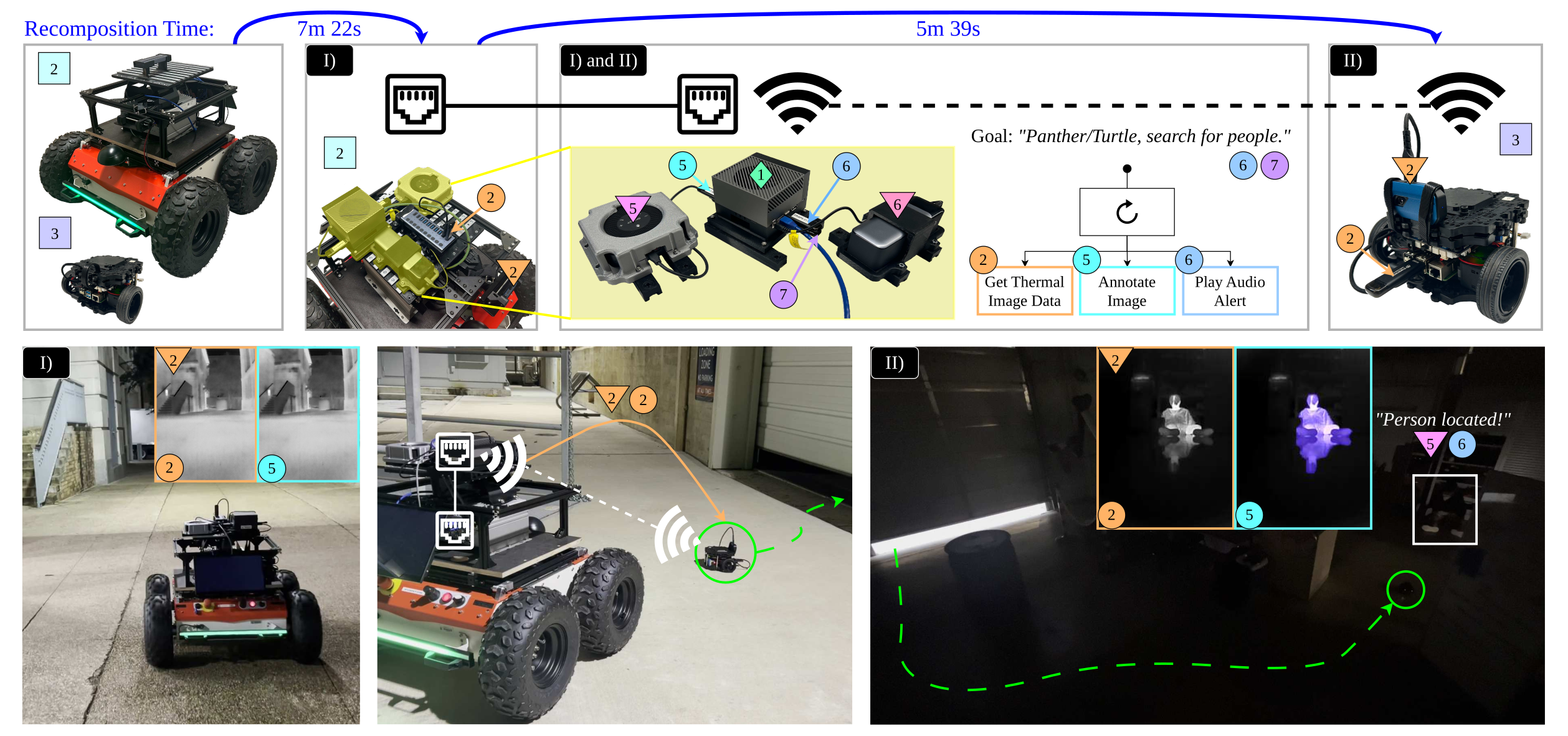
Demonstration 2 — Thermal-Guided Person Search
Scenario. In a mock disaster-search task, a large Panther host robot is
configured to search for people outdoors using a thermal camera, but is too large to fit
through a discovered confined building entryway. A smaller Turtlebot host robot is powered
on and, using resources shared from the external compute payload, enters the building and
continues the search.
Stage I — Outdoor thermal survey with the Panther
A GPU-equipped external compute payload is connected to the Panther over Ethernet and the
two Component Manager instances discover each other automatically. The
compute payload brings its own battery and the speaker and microphone from Demonstration
1, and receives speech-to-text, text-to-speech, local LLM, and image detection/tracking
software payloads, forwarding all databases to the Panther. The thermal camera and
supporting software from Demonstration 1 plug directly into the Panther. The goal
"search for people" produces a task-level behavior tree spanning components on
both systems.
Stage II — Confined-space search with the Turtlebot
The Panther encounters a narrow opening into the affected building. A smaller, modified
Turtlebot is powered on; its Component Manager and the compute payload
discover each other over a shared wireless network and all active component databases are
forwarded. The thermal camera and drivers move from the Panther to the Turtlebot. Given
the same natural language goal, the Turtlebot generates and executes the same task-level
behavior tree, enters the dark interior, detects a person, and alerts the teammate outside
via the text-to-speech software and speaker on the compute payload.
Demonstration 2: Thermal-Guided Person Search consisting of stage
I) an outdoor survey with a Panther robot and stage II) the transition to a Turtlebot
robot capable of entering a dark building through a small opening. Both robots are
initially computationally limited and augmented with the same external compute payload to
run GPU-intensive processes. The external compute payload is connected via Ethernet with
the Panther and wirelessly with the Turtlebot. The top row shows payloads integrated with
each host robot, including the shared external compute payload, alongside the natural
language goal provided to both robots and the corresponding autonomously generated
task-level behavior tree. The bottom row shows third-person images and onboard sensor data
captured during each stage. Software, hardware, and compute payload tags match
Host Robots and Unseen Payloads, and
behaviors and robot data snapshots indicate the components that enable them. Recomposition
time for each stage is shown above the top row.
BibTeX
@misc{swanbeck2026deployment,
      title={Deployment Is Not Destiny: Robot Recomposition in the Field with
             Unseen Software, Hardware, and Compute Payloads},
      author={Steven Swanbeck and Jonathan Salfity and Jeffery Gunawan and
              Corrie Van Sice and Mitch Pryor and Robert Blake Anderson},
      year={2026},
}